

Bringing the ROS Community Together: Meetups in Heilbronn and Karlsruhe
/Beyond the large annual conferences, some of the most valuable moments in the ROS ecosystem happen at a smaller scale, when local developers, researchers, and companies gather in one room for an afternoon of talks, demos, and conversation. Over the spring, the robotics community had two such occasions: the first-ever ROS Meetup in Heilbronn in March, followed by the second ROS Meetup in Karlsruhe in May. Both events reflected a healthy, growing grassroots scene around ROS 2, and both reaffirmed why face-to-face exchange remains so important to the open-source robotics community.
A First for Heilbronn
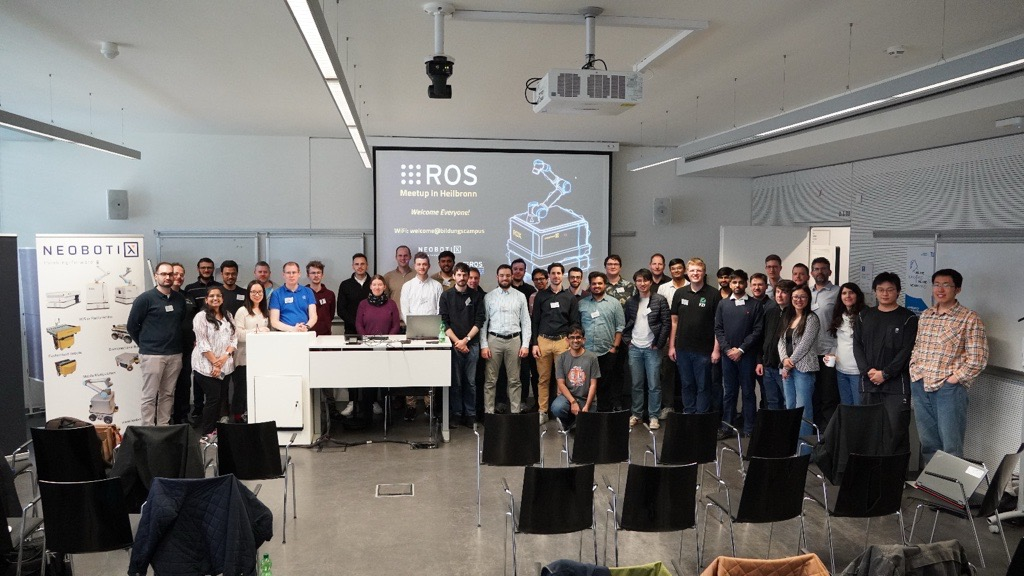
On 23 March 2026, the robotics community came together at the TUM Campus Heilbronn (Bildungscampus) for the first ROS Meetup ever hosted in the city. The event was organized jointly by Neobotix GmbH, TUM Campus Heilbronn, and Fraunhofer IPA, and brought together developers, researchers, and students for an afternoon of talks, lab tours, and networking over a shared lunch at the Bildungscampus.
The afternoon opened with an introduction from Neobotix GmbH before moving into a full technical program. Denis Stogl of b-robotized presented recent improvements to real-time control in ros2_control, focusing on coordinating multiple robots, an area where reliable, deterministic control is essential for industrial adoption. Robert Wilbrandt of the FZI Forschungszentrum Informatik for Information Technology introduced a reusable, MoveIt-based manipulation planning component designed to simplify the integration of motion planning across projects. Vishnuprasad Prachandabhanu and Sanjeev Kumar from Fraunhofer IPA followed with a talk on developing ROS 2 controllers for the Unitree G1 humanoid platform.
The lineup also reached into learning, general-purpose robotics, and safety. Pauline Steffel, a PhD student in the AImotion department, presented work toward a configurable and reusable reinforcement-learning training infrastructure for autonomous mobile robots in ROS 2. Tobias Weyer of TNG Technology Consulting shared a broader perspective on general-purpose robotics with ROS, and Zhen Zhang of TUM Campus Heilbronn closed the talks with research on safe, LLM-controlled robots that provide formal guarantees through reachability analysis.
The presentations were complemented by hands-on demonstrations. Attendees were given an inside look at the research underway in the TUM Cyber-Physical Systems labs, and Neobotix showed several of its professional-grade mobile robots running live. As is often the case, the networking session afterward proved just as valuable as the talks themselves, providing the kind of informal, face-to-face exchange that turns into future collaboration.
Organizing a community event from scratch is no small undertaking, and the success of this first edition owed much to the team at Neobotix together with TUM Campus Heilbronn's Cyber-Physical Systems group, including Prof. Amr Alanwar, Zhen Zhang, and Hadi Elnemr, and the support staff who made the venue and logistics work. ROS-Industrial Europe and Fraunhofer IPA were glad to collaborate on bringing the meetup to life. For a first event, it set an encouraging precedent and showed clear appetite for a recurring gathering in the region.
A Second Round in Karlsruhe
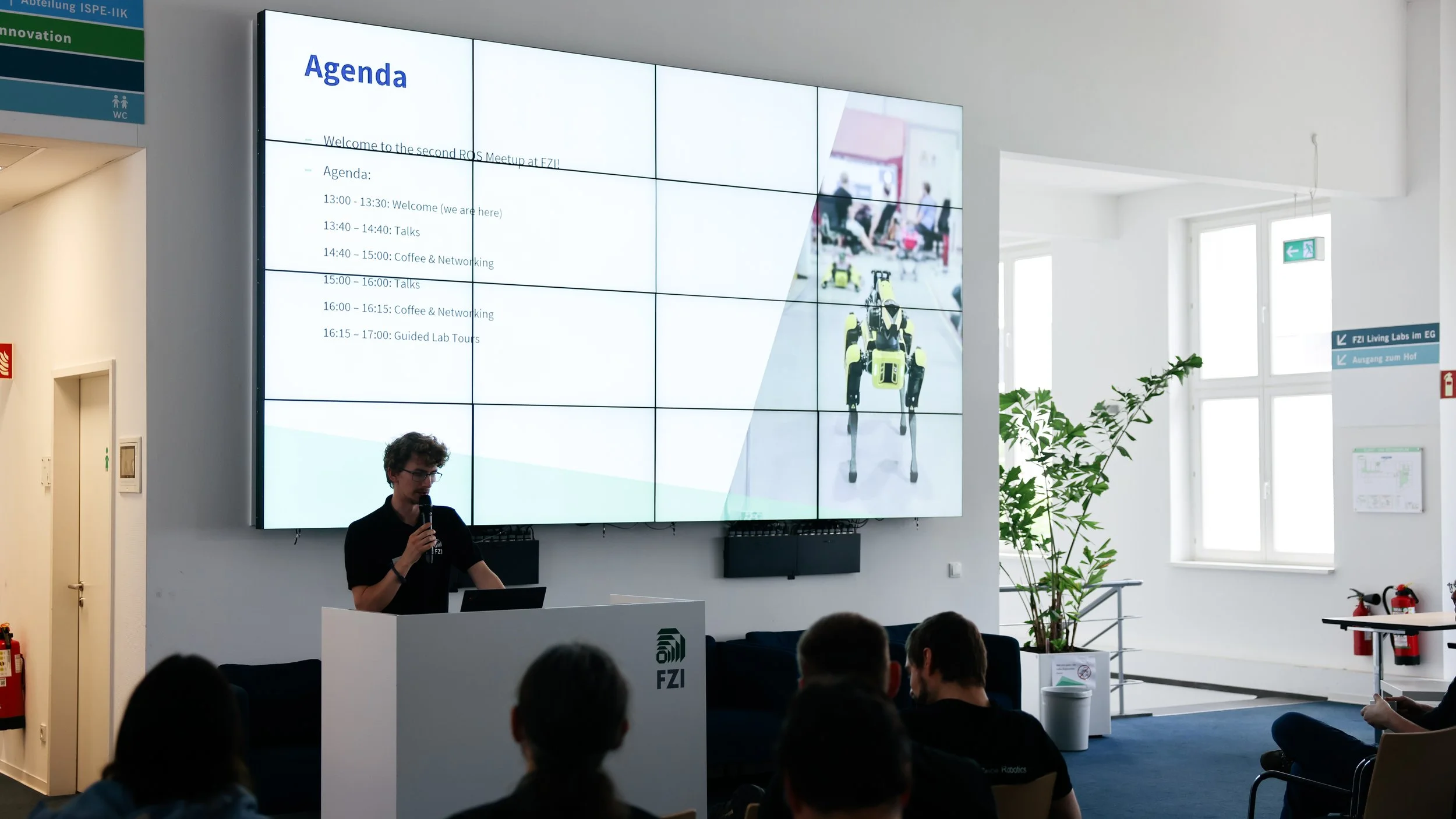
Two months later, on 21 May 2026, the community reconvened at the FZI Forschungszentrum Informatik House of Living Labs in Karlsruhe for the second ROS Meetup hosted there. With six presentations spanning research and industry, the afternoon offered a broad cross-section of how ROS is being applied today, from manipulation and motion planning to medical robotics and industrial machine tools.
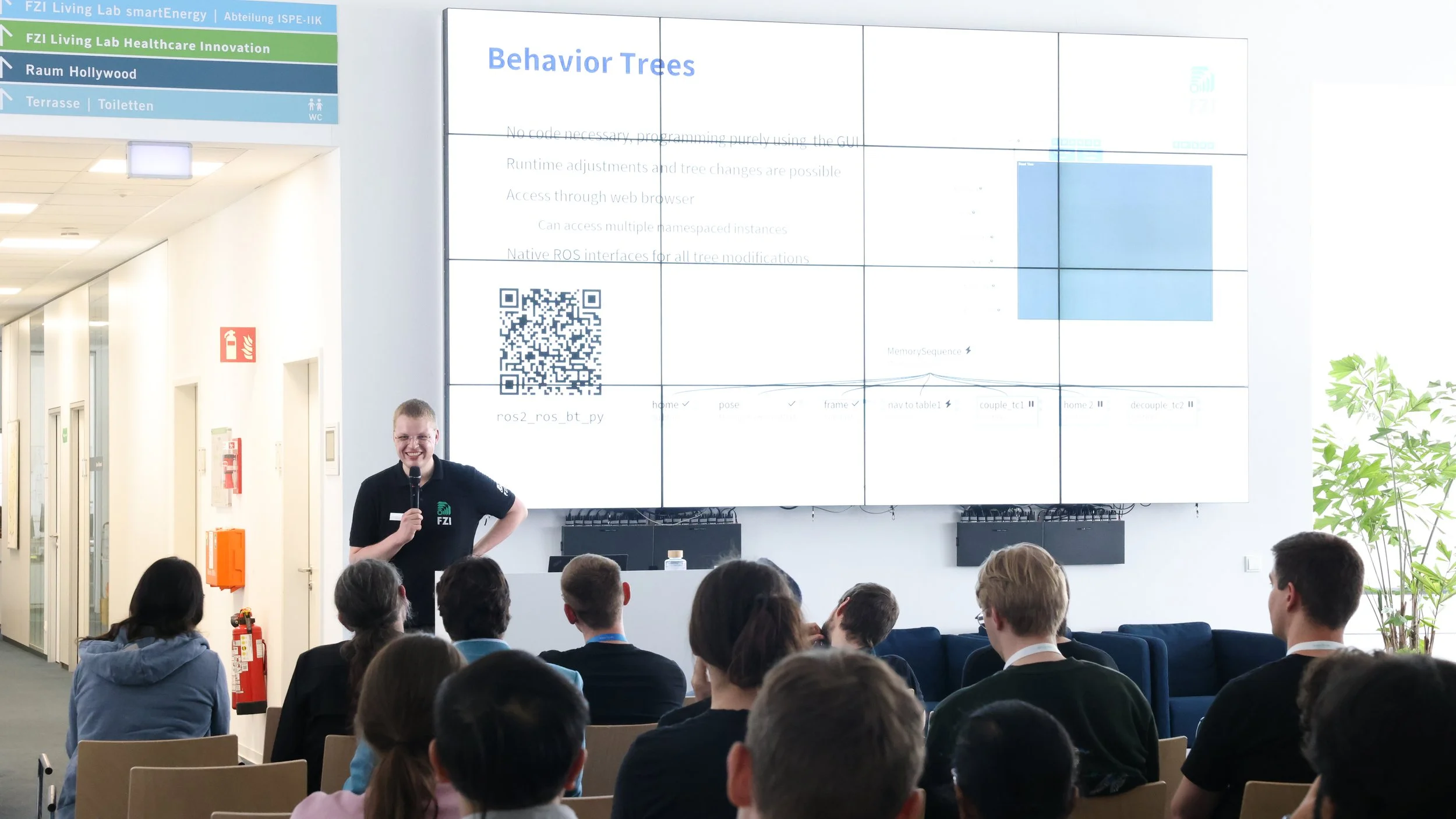
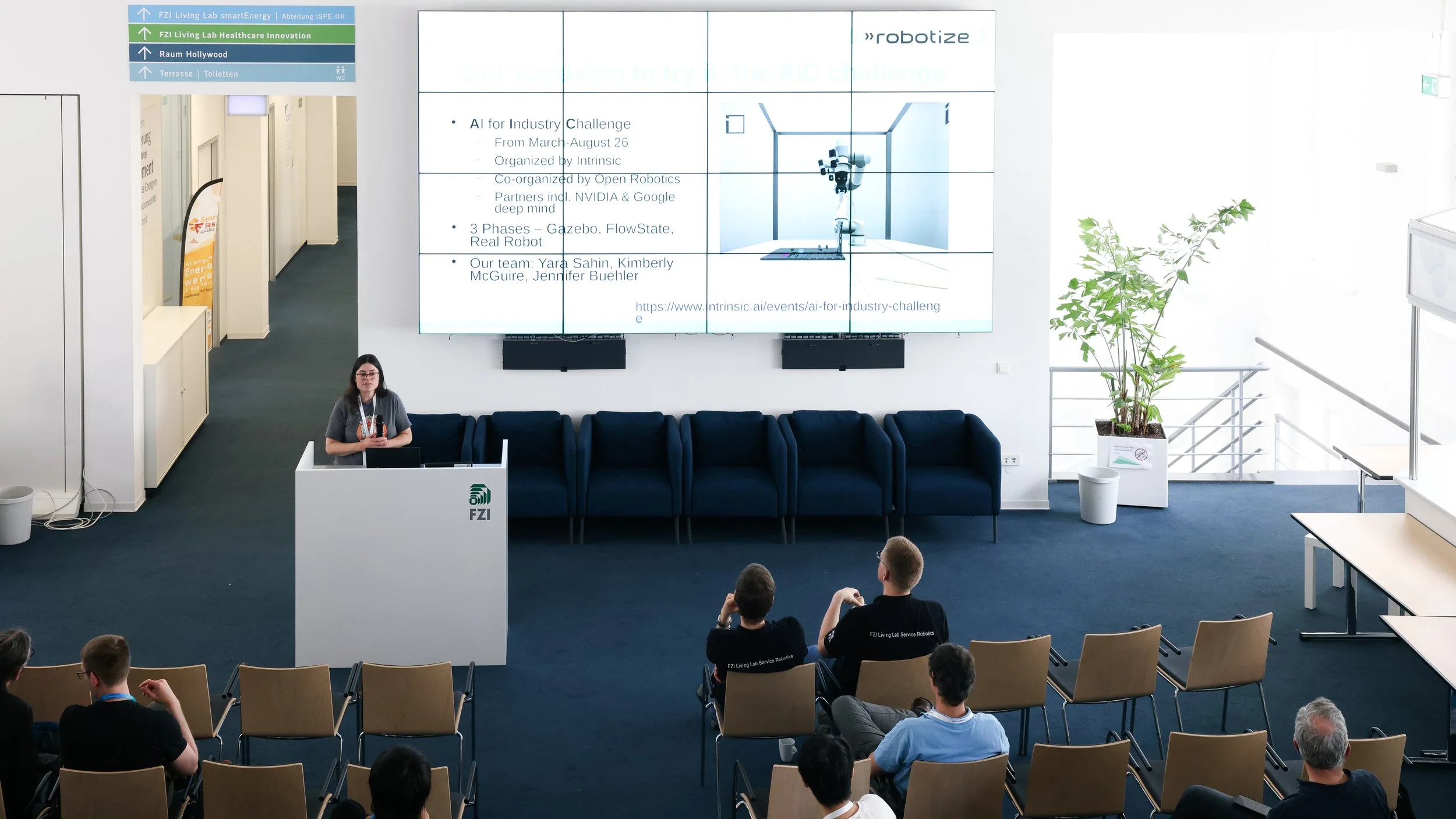
Robert Wilbrandt of the FZI Forschungszentrum Informatik for Information Technology opened the technical program with an overview of how ROS sits at the core of FZI's robotics projects. He highlighted several open-source packages the center maintains, including vdb_mapping for long-term, large-scale 3D mapping and navigation, behavior-tree-based approaches for the automatic, LLM-driven generation of assembly and disassembly programs. Dr. Jennifer Bühler and Dr. Denis Stogl of the b-robotized group followed with their approach to the Intrinsic Industrial AI Challenge using HIL-SERL (Human-in-the-Loop Sample-Efficient Reinforcement Learning), a method that combines a small number of demonstrations with targeted human interventions during training so that manipulation tasks can be learned with far less task-specific data than many current approaches.
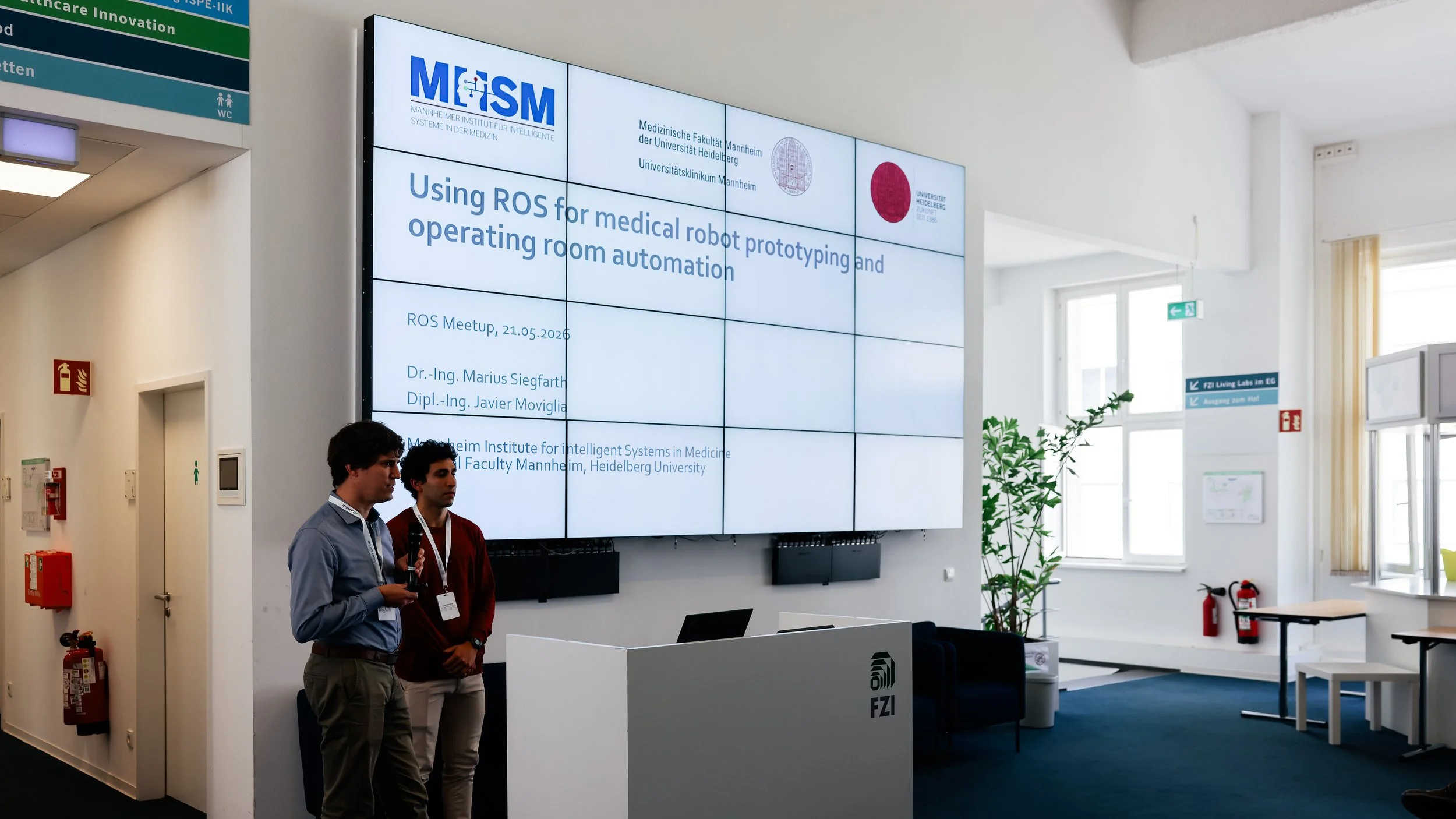
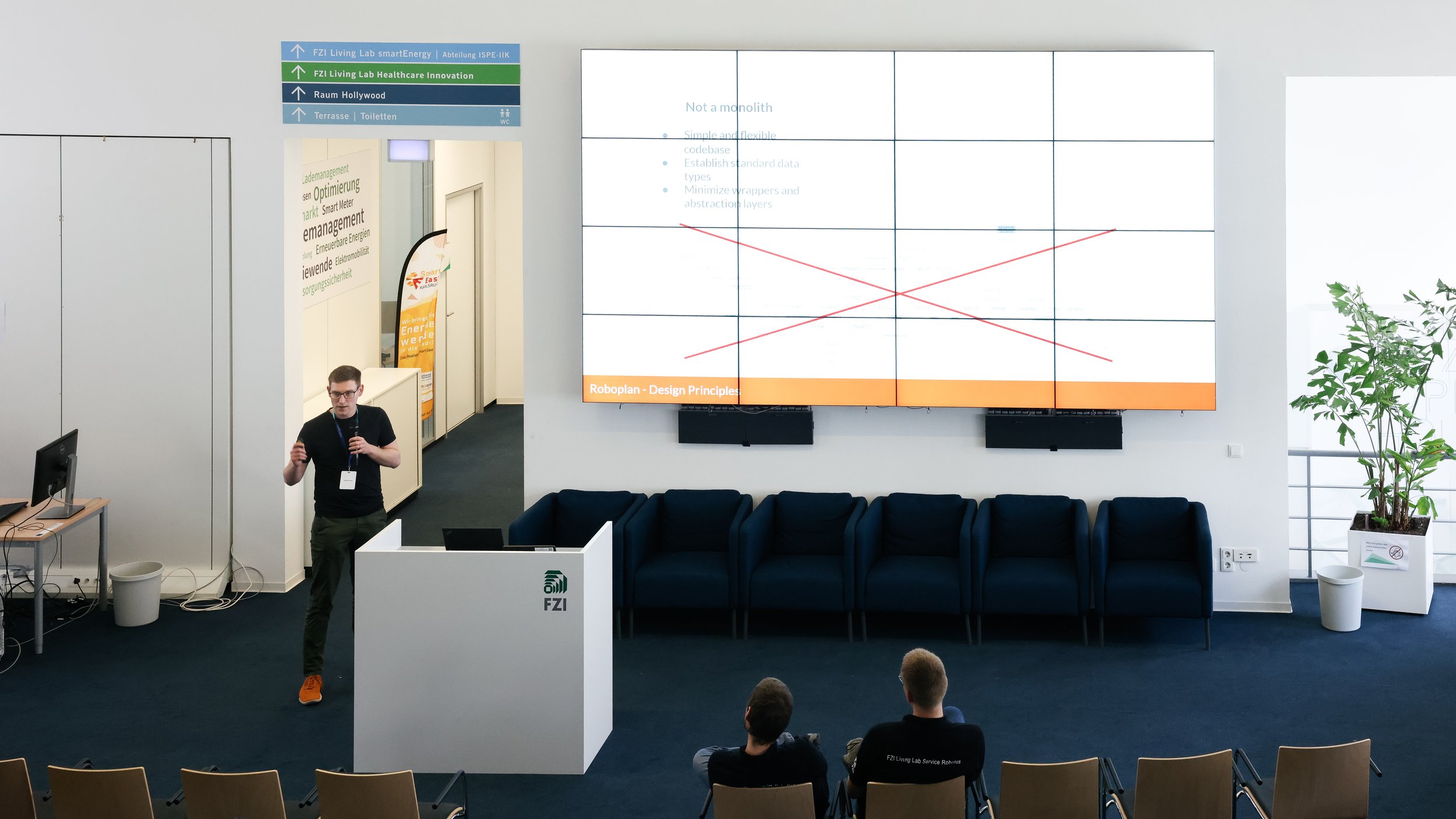
The motion-planning thread continued with Sebastian Jahr of the ZEISS Group, who introduced OInK, an optimal inverse kinematics solver built on Roboplan, an emerging library based on Pinocchio. OInK is a QP-based differential IK solver written in C++ that computes joint commands in real time while tracking multiple objectives and respecting constraints and safety barriers. Dr.-Ing. Marius Siegfarth and Javier Moviglia from the Mannheim Institute for Intelligent Systems in Medicine (Medical Faculty Mannheim of Heidelberg University) then turned the focus to medical robotics, showing how they use ROS to develop robotic prototypes for operating-room automation, integrate them with imaging modalities such as CT and MRI, and connect devices within the OR environment.
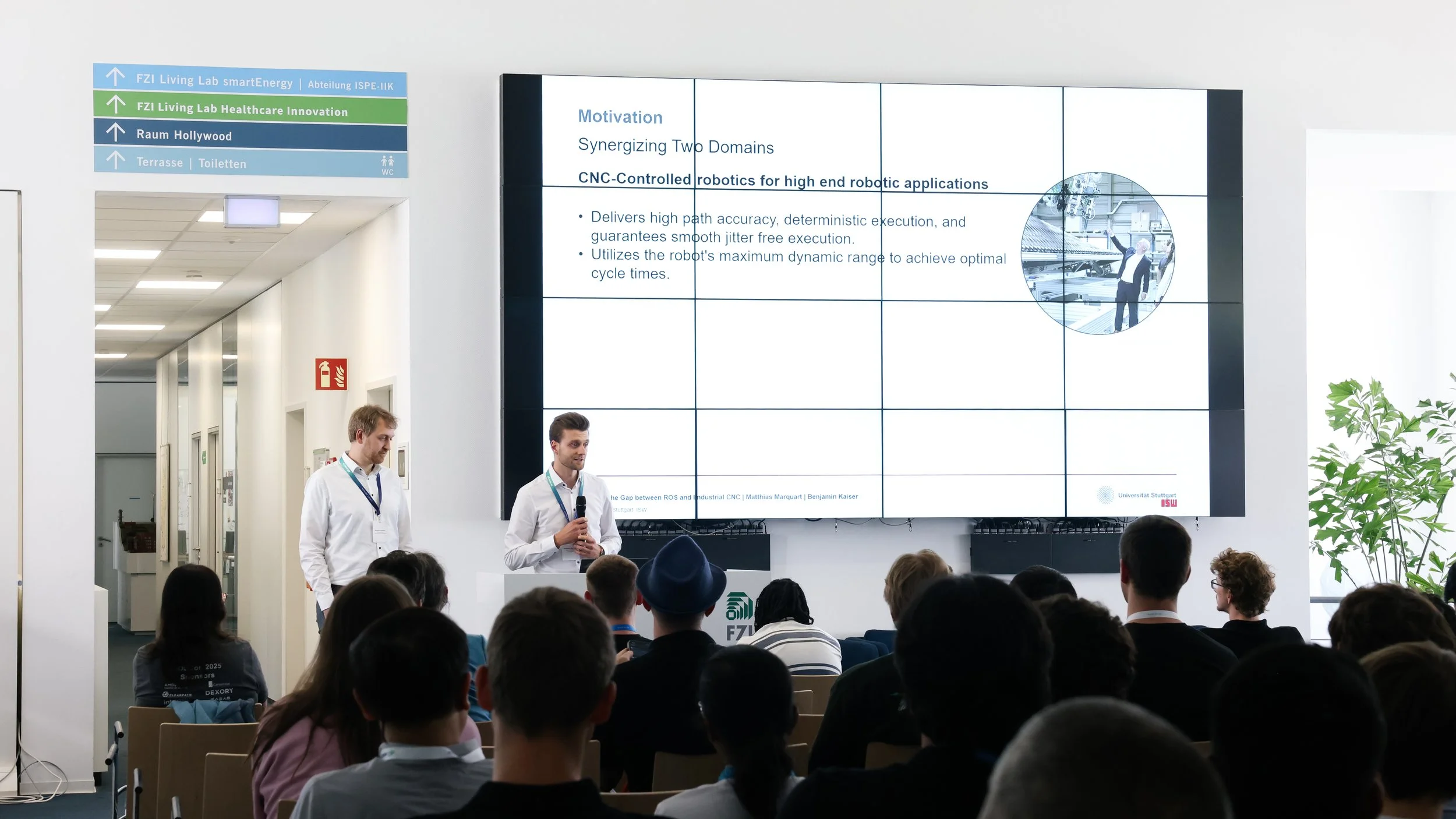
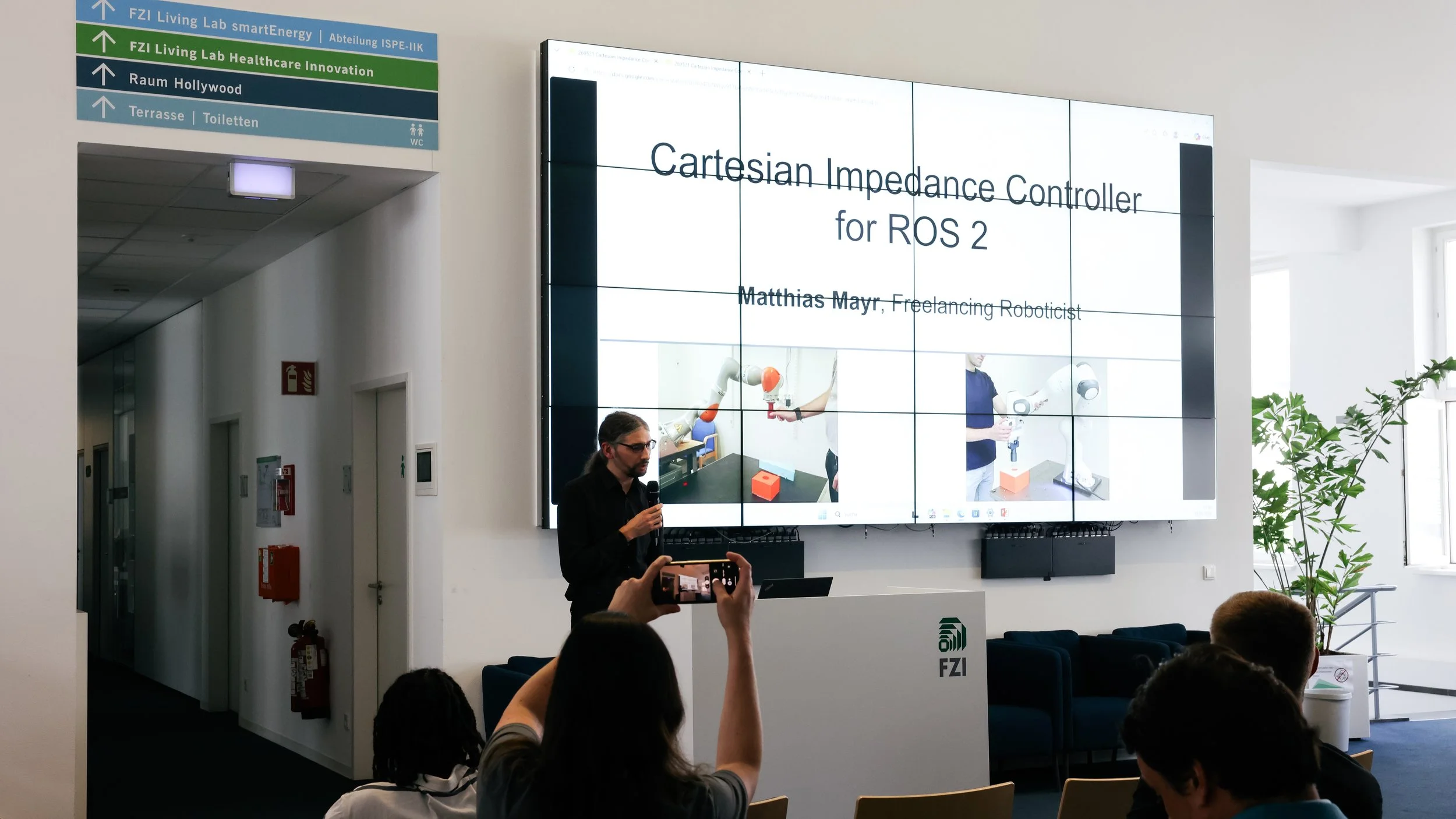
Rounding out the program, Matthias Mayr of Mayr Robotics presented a Cartesian impedance control stack for torque-controlled manipulators. Built with ros2_control, it enables the compliant interaction that many real-world manipulation tasks require and generalizes across platforms such as the Franka Research 3 and the KUKA iiwa. Finally, Matthias Marquart (ISW, University of Stuttgart) and Benjamin Kaiser (ISG – Industrielle Steuerungstechnik GmbH) bridged ROS and industrial CNC. Motivated by use cases such as robotic timber milling, they showed a hybrid architecture in which a TwinCAT CNC triggers a MoveIt planner for collision-free path planning and then executes the resulting path back on the CNC, combining industrial reliability with the flexibility of the ROS ecosystem, before looking ahead to native integration of the ISG-Kernel SDK into ROS.
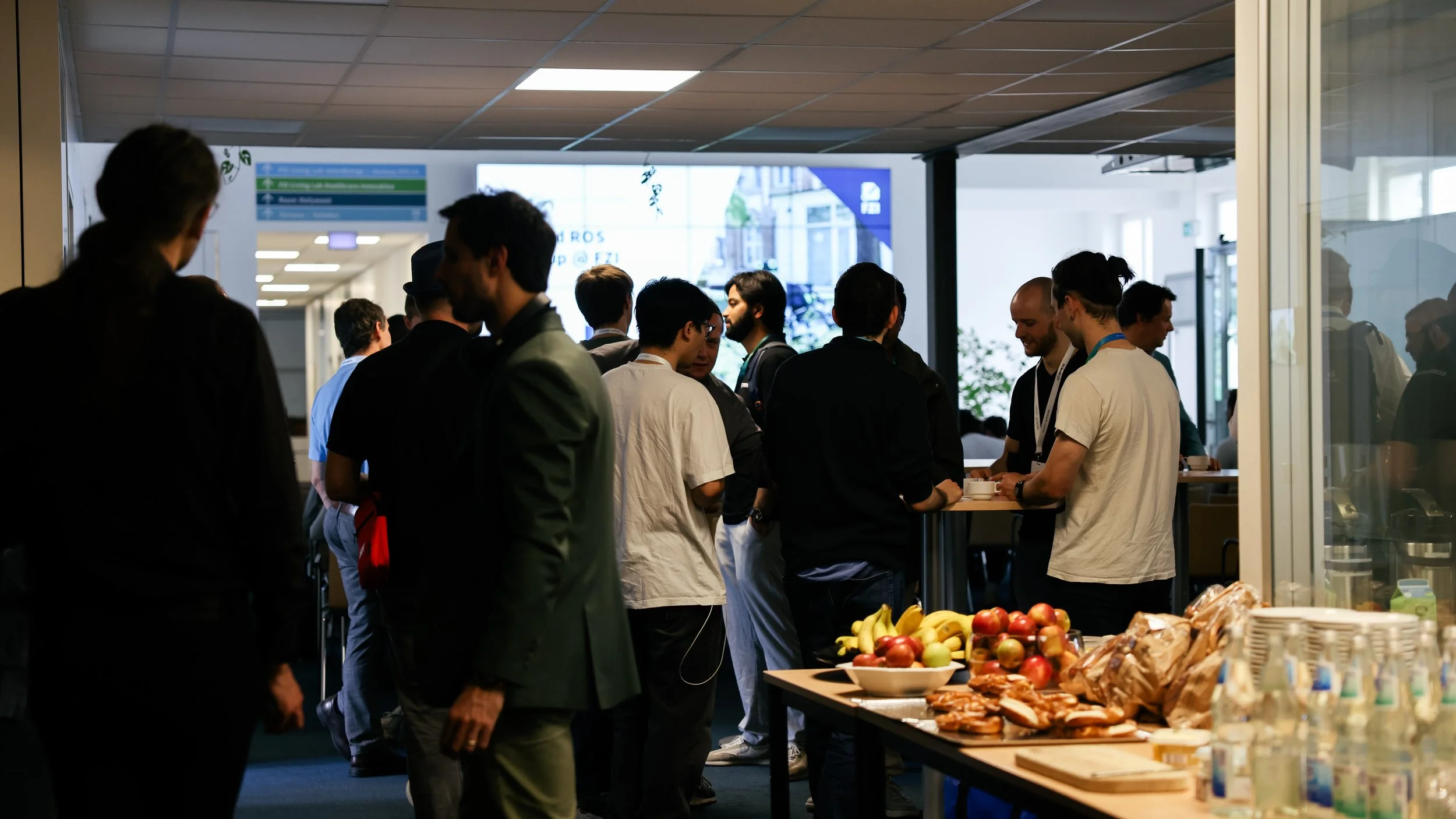
The meetup wrapped up with a tour of FZI's robotics labs, including a showcase of the center's custom-developed legged robots, followed by more networking.
Why These Events Matter
Taken together, the Heilbronn and Karlsruhe meetups illustrate something the ROS-Industrial community has long believed: real-world progress depends as much on people connecting as on code being written. The talks spanned the full breadth of the field, from low-level real-time control and inverse kinematics to reinforcement learning, medical automation, and CNC integration, while the demos and lab tours grounded those ideas in working hardware.
A sincere thank you goes to everyone who made these gatherings possible: the organizers at Neobotix, TUM Campus Heilbronn, FZI Forschungszentrum Informatik, and Fraunhofer IPA, the speakers who shared their work, and the many attendees who brought their curiosity and ideas. With two successful meetups behind us, we look forward to seeing this regional community continue to grow, and to many more afternoons of talks, demos, and good conversation.
Double-click to edit...