CloPeMa Project Leverages ROS-Industrial

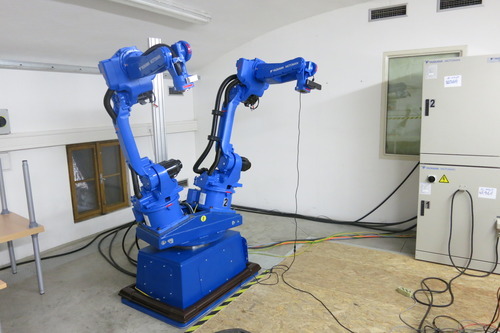
Two MA1400's used in CloPeMa program for manipulation of clothing.

CloPeMa, Clothes Perception and Manipulation, is a European project to research the  manipulation of clothing and other textiles with industrial robots.  The ultimate vision of the program is to autonomously fold “any" kind of clothing.  The grasping and manipulation of flexible objects is a non-trivial problem.  This makes the CloPeMa very exciting.  The research will definitely push the state of the art in robotic grasping and manipulation.  

Five partners are working together on this program:

CTU is utilizing ROS-Industrial to control two Motoman, MA1400 industrial robots.  They are expanding the capability in the Motoman stack to enable multi-robot control.  New capabilities will include the ability two move multiple manipulators at the same time.  The software developed under the CloPeMa project will be released open source.

Further information can be found at the following sites:

Official CloPeMa website

EU-FP7 Project website

ROS-Industrial at ROSCon 2012

This news is a little delayed, but with summer vacations and too much fun coding, time got away from me.  For those of you who didn’t get to attend ROSCon, ROS-Industrial, generated some buzz.

Morgan Quigley, the original architect of ROS, recognized ROS-Industrial in “The Photo Gallery of Robot Awesomeness” portion of his keynote address at the conference. He called ROS-Industrial a solution blending the “cutting-edge, high-level features” of ROS with the “rock-solid, low-level controls” associated with industrial robots, explaining that “the idea of ROS-Industrial is to combine these two worlds to try to get the best of both.”

Another keynote by Steven W. Hart from the joint GM-NASA Robonaut development team called ROS-Industrial a more robust version of ROS, “really pushing in the right direction in terms of adding the reliability, the testing, the performance … characterizing what works and what doesn’t.”
 
“Shaun Edwards came… to Willow Garage to… see what we were doing with our manipulation stack and apply it to industrial robots,” explained Willow Garage’s Sachin Chita, during a talk titled, Motion Planning in ROS. “And it was actually a fantastic effort.” He played a video of ROS-Industrial controlling a Motoman robot, performing collision-free grasping of multiple objects of different shapes and materials.

I’m very thankful for the kind mentions about ROS-Industrial at ROSCon.  I think it goes without saying that ROS-Industrial, a team effort in and of itself, is an extension of ROS, for which many deserve credit.

ROS-Industrial Program Update

I thought I would take some time to provide an update on the current state of ROS-Industrial.

Consortium - The ROS-Industrial Consortium is one step closer. We have put some preliminary information out of the web (http://www.swri.org/4org/d10/msd/automation/ros-industrial-consortium.htm) and have created a video ( http://www.youtube.com/watch?v=h54YzGIZFt4 ). We are very excited for this opportunity to expand the support for ROS-Industrial. Feel free to share this information with anybody you think might have interest.

Twitter - We’ve created a twitter account for ROS-Industrial: http://twitter.com/rosindustrial Follow us for status updates. We will be posting videos, articles, and other information as it becomes available.

Freetail Program - We have talked to several companies that have identified “bin picking" or “kitting" as opportunities of interest. As a result, we have approved another round of funding for refining and impoving pick and place capability. The software developed under this program (code named Freetail) will be released open source ( http://code.google.com/p/swri-ros-pkg/source/browse/#svn%2Ftrunk%2Ffreetail ). We are actively looking for commercial partners and others to assist in this research.

Mini-Project List - I have updated the mini project list on the google code wiki (http://ros.org/wiki/Industrial/Roadmap/ ). I would like to invite you guys to give us feedback on the list. Additions are also welcome. This list will be included as potential projects for funding by the Consortium once it is funded. If you have a particular need or project idea, this might be a possible way to get it developed.

Volunteer Opportunities - We are still feeling our way out on managing ROS-Industrial as an open source program. We truly believe that community involvement will be the key to it’s success. For those who might be interested, I would like to know if there are volunteers to create robot configurations for the various types of industrial robots. We have tutorials on the wiki. By simply generating these configuration files, we can give people the ability to test high level functions, such as path planning, using the Rviz visualization environment.